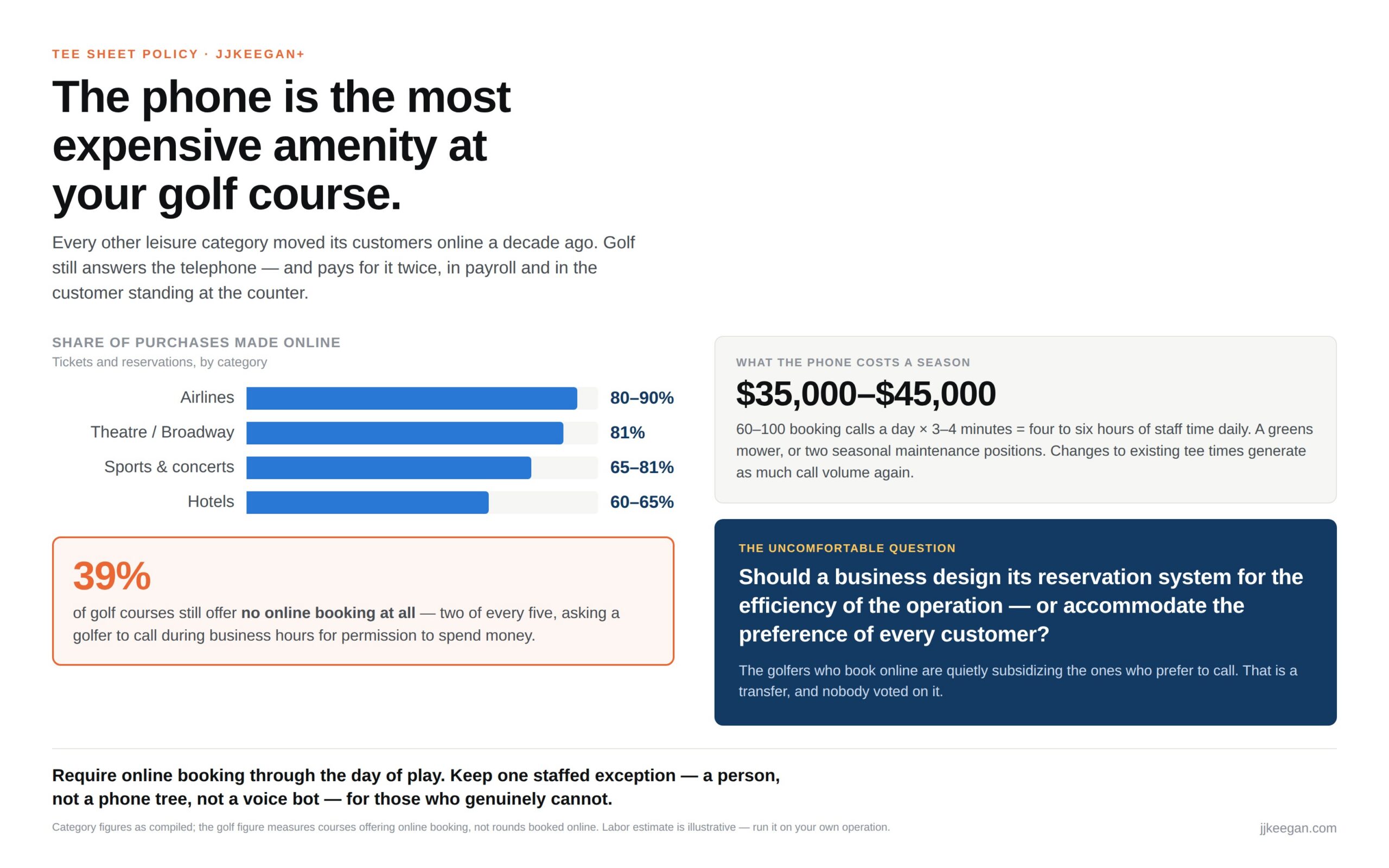
 The rest of the leisure economy settled this question a decade ago.
Roughly 81% of event tickets are now purchased online. Airlines book 80–90% of flights through their own channels, with only about 13% flowing through the OTAs. Hotels run 60–65% online. Nobody calls United to ask what seats are open on Thursday.
Golf is still debating whether to have online booking at all. About 60% of courses offer it. Which means 39% — two of every five — still require a golfer to telephone to ask permission to spend money.
I want to make an argument that is less popular than it should be: municipal and daily-fee courses should require online booking through the day of play and should stop taking tee times by telephone altogether, save for one deliberate exception.
Run the arithmetic on the phone
Nobody puts the telephone on the P&L, so nobody sees what it costs.
Do the math on your own operation. A booking call takes three to four minutes, including the hunt for a time that works, spelling the name, and pleasantries. A moderately busy municipal course fields somewhere between sixty and a hundred booking-related calls on a summer day. Call it four to six hours of staff time daily. At a fully loaded twenty dollars an hour, that is roughly $100 to $130 a day, or $35,000 to $45,000 across a season.
That is a greens mower, or two seasonal maintenance positions you told the city you could not afford.
And direct labor is the smaller half of the cost. The larger half is what the phone does to the counter. The golfer standing in front of your attendant — the one who has already driven to your property and is holding a credit card — waits while the phone is answered. We have built an operation in which the customer who is physically present is systematically subordinated to the customer who is not.
Then run it again on changes
Booking is only the first call. The tee time is a living thing. Groups grow from three to four and shrink from four to two. Saturday at 7:40 becomes Saturday at 9:20, then Sunday. Weather arrives on Thursday for a Saturday round, and the whole sheet reshuffles by telephone.
In my experience, these modifications generate as much call volume as the original bookings, sometimes more, and each one interrupts the shop mid-transaction. Online, the same change costs the operation nothing. The golfer makes it himself, at 11 p.m., in fifteen seconds, and the sheet updates without a human touching it. He is often happier that way — he need not wait for the shop to open or apologize for changing his mind a third time.
This is what operators underestimate. For the modification, self-service is not merely cheaper. It is better service.
The uncomfortable question
Here is where the argument gets honest, and where I suspect most of my colleagues will part company with me.
Should a business design its reservation system for operational efficiency, or should it accommodate every customer’s preference?
Golf’s reflex answer is immediate: we are hospitality, we serve, and the golfer who wishes to call is a customer. That instinct is why most of us entered this business.
But examine who actually pays for it. Every dollar spent answering telephones is a dollar not spent on the golf course. Seventy percent of your golfers who book online, quickly and without assistance, are quietly subsidizing the thirty percent who prefer to call. That is a transfer, and nobody voted on it. When we describe accommodating every preference as providing superior customer service, we should be candid that other customers fund that generosity.
There’s also a form of customer service that looks less like service and more like quiet conflict avoidance. We keep the phone line open not because it’s the best operational choice, but because closing it would mean having twenty long‑time regulars asking why their preferred tee times are no longer just a phone call away. In trying to spare feelings, we end up giving a small group priority over everyone else who simply wants a fair chance to play.
And while we’re busy managing those expectations, the irrigation system reaches year fourteen of a twenty‑year life and begins to fail. When we say we were underfunded — but the truth is more complicated. Our desire to keep everyone happy in the moment can quietly pull resources and attention away from the long‑term needs that keep the course healthy and thriving.
What that path looks like
Not a phone tree. Not an AI voice bot that lets a golfer talk his way through a booking — a tee sheet open online at 2 a.m. has no call to answer, and the unanswered telephone is a symptom of a closed booking window, not of an absent robot.
Using a phone bot for golf reservations may seem efficient on paper, but in practice it often erodes the very experience golfers value. Golfers calling to book a tee time are usually seeking a human connection — someone who can understand nuances, answer questions, and help navigate weather, pace‑of‑play concerns, or special requests.
A bot can’t interpret tone, urgency, or context, and it certainly can’t build rapport with regulars who have supported the course for years. Instead of reducing workload, it often increases frustration: golfers get stuck in menus, misunderstand prompts, or abandon the call altogether. What feels like a cost‑saving measure can quietly damage trust, reduce loyalty, and create friction at the exact moment when a golfer is deciding where to spend their time and money.
The answer is the human being in the pro shop taking calls only for the day of play in which the initial greeting indicates the number of times available that day. Taking a reservation in person or by telephone is an efficient method of filling last-minute cancellations. A municipal or daily fee course carries an obligation a resort does not, and that obligation is met by one well-staffed door — not by keeping every door open.
The City of Golden runs Fossil Trace with the sheet open online through the day of play. The Heritage courses here in Colorado — Bear Dance, Colorado National, Plum Creek — do the same. These are competitive Front Range operations, not laboratories, and the sky has not fallen.
Securing online reservations with a credit card and a modest advance fee — fully credited toward the green fee — dramatically reduces no‑shows. When courses take the next step and require full prepayment, as CommonGround Golf Course does under the Colorado Golf Association, revenue reliability increases even further.
The truth is that our customers stopped wanting to call fifteen years ago. We’re simply the last ones still picking up the phone, holding onto a habit that no longer serves the golfer or the operation.