A new book by James J. Keegan
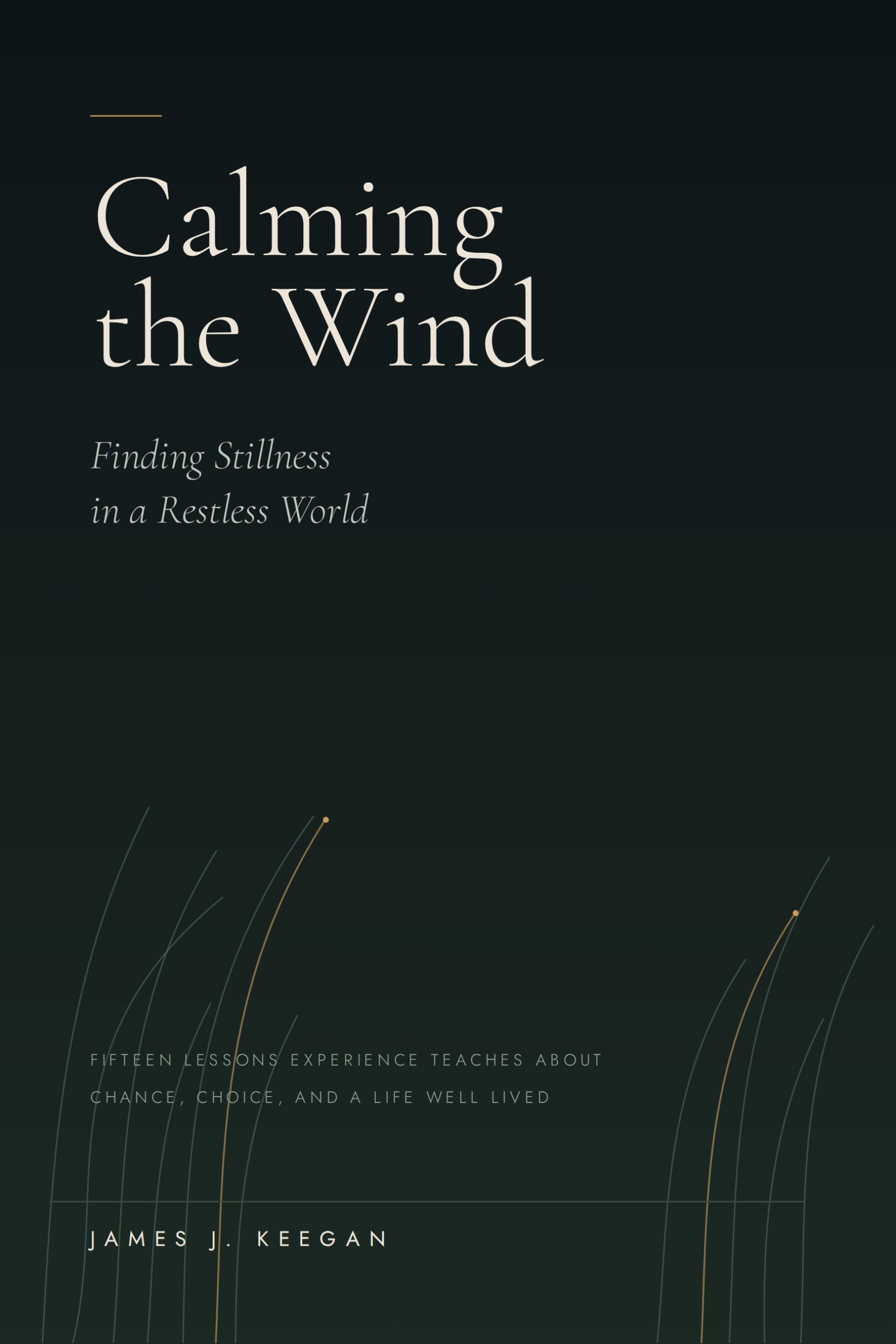
Calming the Wind
Finding Stillness in a Restless World
Fifteen lessons for navigating chance, choice, and life’s inevitable truths, written by a father for his daughter and shared for anyone deciding what to do with the rest of their life.
The plan in the bookcase
It began with a binder filled out in 1979.
Ten feet from where the book was written sits a tattered binder: two sections, fifteen chapters, prepared with a career counselor and meant to say what to do with the rest of a life. It was written by a young CPA with an MBA, four years as an Air Force captain, and five years at Peat, Marwick, Mitchell behind him.
Nearly fifty years later, the most insightful page in that binder turned out to be the one left blank. Chapter 9 was marked Not Used. It came to hold everything that could not have been planned: a company not yet imagined, countries not yet seen, and the people who drifted in on the current and stayed.
Calming the Wind is the account of what came true, what quietly faded, and what was learned along the way.
Life Review & Planning · 1979
Section 1 · Life Review — Personal
- 01Goals, Policies, Procedures and Tasks
- 02Summary of Financial Position and Forecast
- 03Personal Balance Sheet of Strengths and Weaknesses
- 04Suggested Personal Improvements
- 05Monthly Emotional Cycle
- 06Social Objective: General and Time Forecasted
- 07Favorite Quotes
- 08Personal Quotes
- 09Not Used
Section 2 · Life Planning — Business
- 10List of Accomplishments
- 11Vocation Inventory and Personality
- 12Career Plan: Short, Intermediate, Long Term
- 13Career Objectives
- 14SIC List of Interested Industries
- 15Summary Resume
The method
Three columns, and the wisdom to know the difference.
Every lesson in the book is an exercise in sorting. Each one lifts something out of the first two columns and returns your attention to the third. What remains is smaller than you expect, and entirely yours to manage. That is what the book means by stillness: not a life free of difficulty, but a life free from carrying what never belonged to you.
One example · Lesson 10
No one has ever been argued into changing.
They did not change. The harder you pushed, the harder they held. That outcome was never yours to own.
Other people, all of them. The ones you love, and the ones you are absolutely right about. Their growth, their choices and their timing belong to them.
Say the true thing once, and stay. Then bring the rest of your energy home and spend it on your own path. Growth is contagious, but it cannot be forced.
Inside the book
The fifteen lessons
Arranged as an argument in five parts, to be read in order. Each closes with a Ground Rule and a gathering of thoughts on the subject from across the centuries.
Part 1
Ground Rules
- 01BalanceAll of life is in balance.
- 02PerspectiveSuccess is not a destination; it is a journey.
- 03ChanceFar more of a life is decided by chance than anyone is willing to admit.
- 04CertaintyCertainty is the poorest available evidence of being right.
Part 2
The Playing Field
- 05GovernmentWorld peace is a utopian concept that cannot be achieved.
- 06ReligionEquality is an ethical and not a biological principle.
- 07BusinessCapitalism constantly devours its own creations.
Part 3
Crowd Noise
- 08Common TraitsOur needs can be met, but our desires can never be satisfied.
- 09Essential DifferencesMost people fail to take the initiative because they overestimate the strength of others.
- 10ChangeNo one has ever been argued into changing.
- 11Various ChallengesA person’s life will always be filled with problems.
Part 4
The Game Plan
- 12TimeA person will never have sufficient time to accomplish all that they desire.
- 13Goal SettingPeople fail because they do not think through their personal goals explicitly, and therefore never commit to a direction.
Part 5
The Reckoning
- 14The BodyThe body keeps its own accounts and presents the bill on its own schedule.
- 15LossEverything you love, you will lose; loving it was still the right decision.
Free companion workbook
The Life Implementation System
The lessons are the book. The workbook is the workshop behind it. Fifteen practices, one for each lesson, each produce a single piece of material: a list, a number, a sentence. The Blueprint assembles them into a written life plan you can draft in one evening, and The Rhythm of the System keeps it running with an hour’s review each quarter.
A hardback is a poor place to fill in blanks, so the writing pages live here. Print them as often as you need.
Readers of the book reach the workbook from the code in the appendix: jjkeegan.com/calmingthewind
- 1Noticing the Corrections
- 2Keeping Things Their Size
- 3Counting the Tries
- 4The Ninety-Second Test
- 5Sizing the Feeling
- 6The Four Jobs
- 7The Durable Ledger
- 8Needs and Wants
- 9The One Fair Comparison
- 10The Level-Five Sentence
- 11Choosing Your Problems
- 12The Time Journal
- 13The Four Lines
- 14The Body Account
- 15The Two Lists
How it begins, and how it ends
A gift for Michaela
The book began as something a father wanted to leave his daughter: more useful than advice delivered in passing, and more enduring than any material inheritance.
“Michaela, some of these lessons you may not believe yet. I did not believe many of them at your age. Keep them anyway, the way you keep a letter you are not yet ready to answer. One day, a few of them may prove to have been written for exactly the week you are having.”
“You cannot calm the wind. You were never asked to. Set the sail, name the port, and go.”
About the author
James J. Keegan
J. J. Keegan is a certified public accountant, a former captain in the United States Air Force, and a veteran of Peat, Marwick, Mitchell (now KPMG). He holds a BBA from Texas Christian University and an MBA in finance from the University of Michigan.
He founded a golf software company that served more than 500 courses in four countries before selling it in 2000, and has since guided municipal and private golf courses across the United States as a financial strategist. His series The Business of Golf is used as a capstone text in Professional Golf Management programs, and Greg Nathan, CEO of the National Golf Foundation, has called him “golf’s answer to Moneyball.”
For more than forty years he has read balance sheets for a living. Calming the Wind applies the same discipline to a life: recognizing the assets that never appear on a balance sheet, and the liabilities that must be managed. He lives in Castle Pines, Colorado.
- Seven editionsThe Business of Golf, 2010–2024
- 16 countrieswhere his books have been purchased
- 500+ coursesserved by the software company he founded
Release, book clubs and speaking
Be the first to know
To hear when Calming the Wind is released, or to invite J. J. Keegan to speak with your book club, team or organization, write to him directly.
jjkeegan@jjkeegan.com