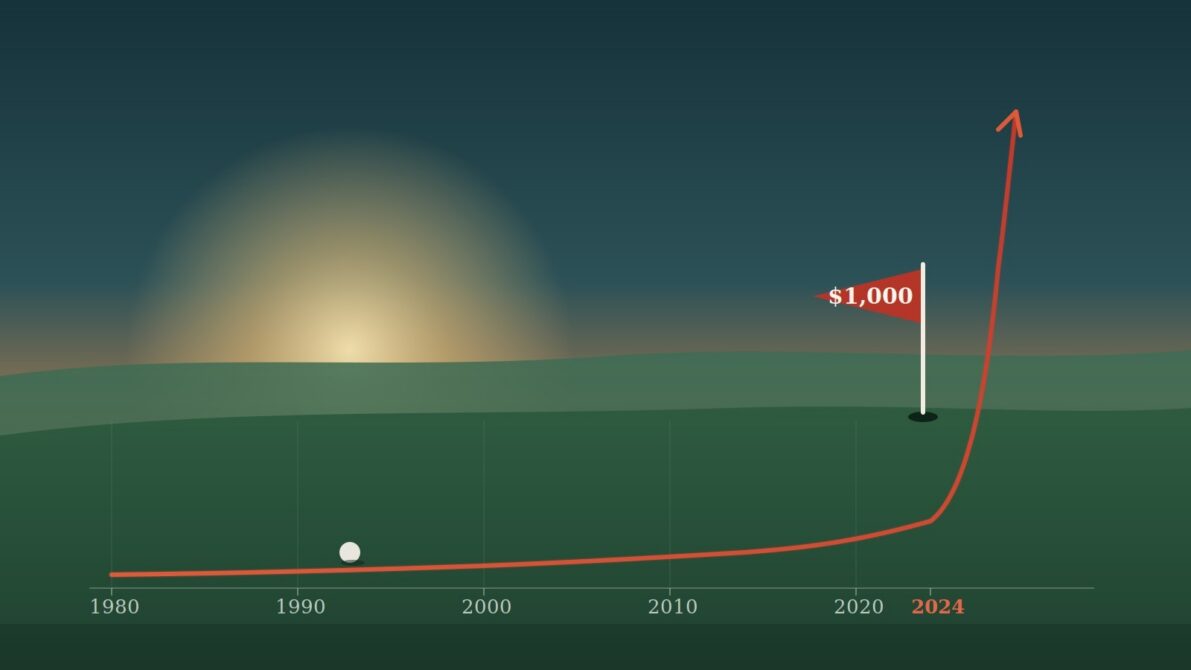
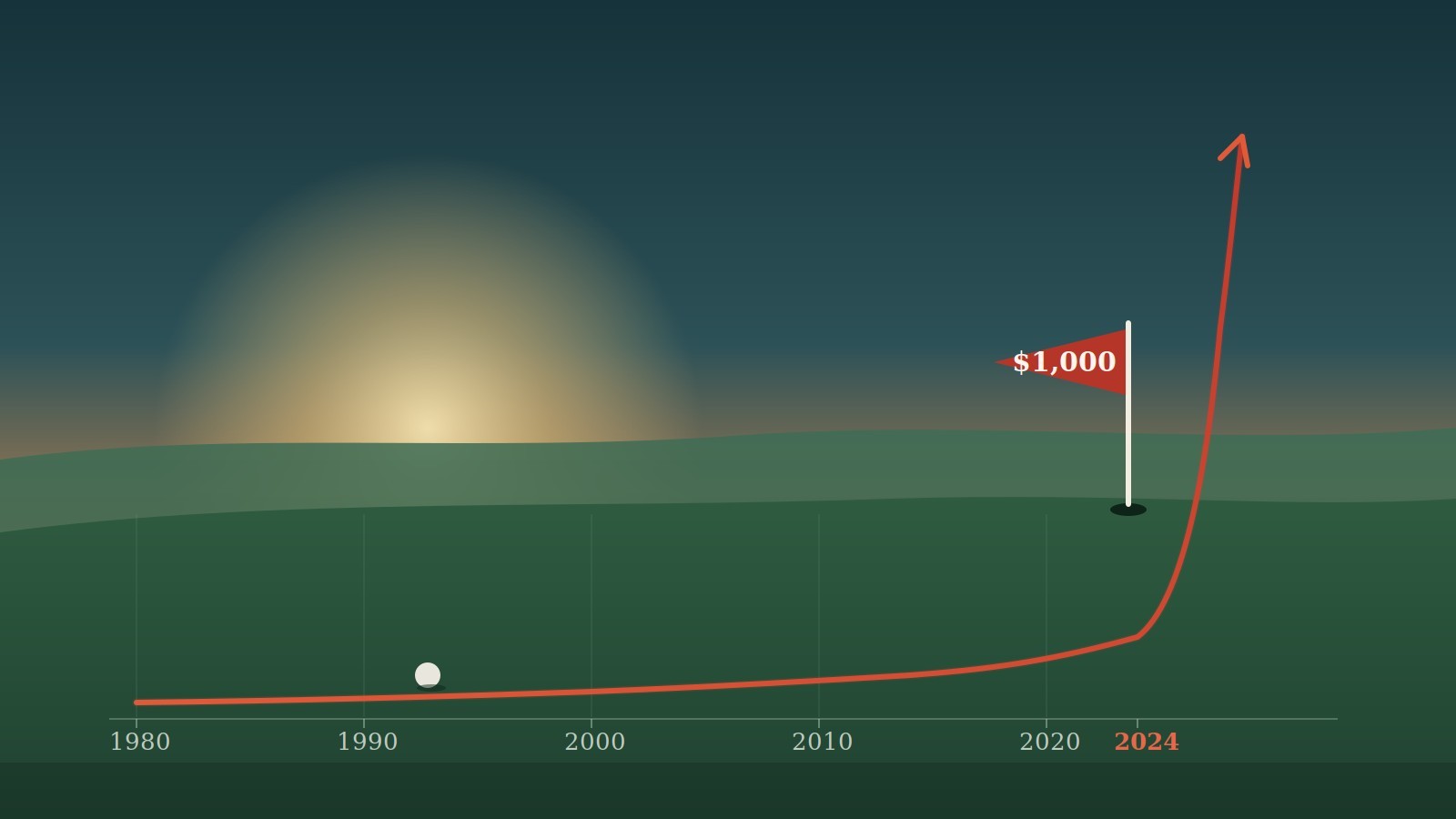
 Golf is riding a high that shows no signs of slowing.
Participation continues to surge, and rounds played across the country remain near all-time highs. But behind the crowded practice ranges and booked-solid tee sheets lies an uncomfortable reality: as demand rockets upward, the cost of admission is climbing at a staggering pace. The sport is testing the financial limits of its audience, leaving players across every demographic asking one fundamental question: what is the ceiling?
Nowhere is that inflation more glaring than at the top of the game. A bucket-list trip to any of the Top 100 golf resorts in the U.S. now routinely requires an outlay where accommodations and green fees together clear $1,000 per round. The destination trip—once an occasional splurge for dedicated players—has become an exclusive luxury accessible to only a select few. A three-night trip to an Oregon resort, booked in November 2025 for tee times in April 2027, ran $5,400 per person.
The private club landscape tells the same story, erecting unprecedented financial barriers to entry. Non-equity initiation fees frequently top $75,000, accompanied by annual dues exceeding $15,000. For a member who plays 20 to 30 rounds a year, the effective cost per round sails past the $1,000 mark before cart rental, food and beverage, lockers, bag storage, and handicap fees are even counted.
And here is the question the invoice never answers: is any of this buying a proportionally better experience, or simply boosting corporate net income? Agronomy has improved and clubhouses are more opulent than ever, but the core product—18 holes in the fresh air—remains fundamentally unchanged.
The Quiet Economics of Familiarity
There is a further dimension the invoice never shows, and it is one every student of finance learns early: diminishing marginal utility. Each additional unit of the same good tends to deliver less satisfaction than the one before it. A great golf course is no exception. The first time you walk a storied layout, every hole is a revelation; by the fiftieth time, even a masterpiece has become a familiar friend rather than a thrill. Familiarity carries its own comforts, but it is not the product you paid a premium to discover.
This is exactly where the membership math turns against the member. The fee paid up front creates pressure to play often, to ‘lower’ the cost per round—yet the more you play the same course, the less incremental joy each round returns. You are amortizing a fixed cost against a stream of experiences whose value is declining with every repetition. The destination golfer at least buys novelty with those four figures; the member, more often than not, is buying repetition at a premium. Both are expensive. Only one keeps paying dividends.
This is not an argument against belonging to a club—community, convenience, and the comfort of a home course carry real, durable value. It is a reminder that price and value diverge faster than we like to admit, and that an escalating fixed cost sits on the wrong side of a declining utility curve. If the joy of a great course peaks on the first encounter and erodes with each repetition, at what point does a rising fixed cost simply outrun the experience it is meant to buy?
The Same Story, Closer to Home
If this were confined to luxury resorts and gated communities, it would be a narrower conversation. It is not. The same pressure is compounding down to the public and municipal courses that have always been the true backbone of the game.
Dynamic pricing—the same yield-management logic the airlines perfected—has arrived at the local level, pushing weekend-morning green fees to levels that would have been unthinkable a decade ago. Cart fees have climbed from $15 to $25 a seat. When City Park in Denver reopened after renovation in 2019, eighteen holes with a cart cost $40. Today it is $82: more than a doubling in roughly seven years, a compound annual growth rate north of 10 percent—on the very course meant to welcome newcomers, families, and players of modest means.
Set against other uses of a discretionary dollar, the return looks thin. Two hours of tennis on a public court costs next to nothing, or perhaps $20 to $30 an hour indoors. A full day on a premium ski mountain runs roughly $25 to $40 per hour on the slopes. A top-tier round of golf now costs $200 to $250 per hour across four hours. How does an industry that depends on a steady pipeline of newcomers reconcile that cost-per-hour with its stated commitment to growing the game?
A Personal Reckoning
I write this as someone the game has been extraordinarily good to having played golf in 43 countries. I have been fortunate enough to play 91 of the Top 100 courses in the world—a milestone I reached in an era when access was earned more through passion and perseverance than through sheer wealth.
I began as a caddie earning $4.00 a round and a twenty-five-cent meal ticket for a hamburger and a Coke at Philmont Country Club, a Willie Park–designed course in Huntingdon Valley, Pennsylvania. I counted every one of those dollars, and I suppose I never stopped; the habit of weighing what a dollar actually buys is what eventually made me a decent accountant.
So it should carry some weight when I say that I recently did what that discipline required: I cancelled two upcoming trips to leading resorts, having concluded that the experience would not be worth its cost after having visited them previously.
There was no anger in the decision—only the same unsentimental calculation I would bring to any other outlay. The magic of the game hasn’t dimmed for me. But the return on the dollar has, and a fiscal conservative who ignores his own math has no business claiming the label.
Questions Worth Debating
I don’t raise these as grievances, and I am emphatically not asking anyone to cap a price or regulate a market—I believe in neither. I raise them as the questions any numbers-minded person would put to the operators, owners, and club leaders who care about golf’s future as much as I do:
- Where is the ceiling—and are you watching for it? Demand looks inelastic today. Every market discovers its elastic point eventually. Do you know where yours is before you find it the hard way?
- Is value keeping pace with cost? Value is a ratio. Is the experience improving as fast as the invoice, or is price simply outrunning scrutiny because the tee sheet stays full?
- Have you priced in diminishing utility? As a great course grows familiar, each replay returns less joy even as the fee holds firm. What, precisely, is the member paying a premium for on the fiftieth round?
- What is a loyal customer actually worth over time? Optimizing revenue per round today can quietly raise churn tomorrow. Are near-term rate increases worth the lifetime customers they may cost?
- Who are you pricing out—and what does that cost later? The caddie, the junior, the retiree on a fixed income, and the family at the municipal course are today’s marginal customer and tomorrow’s core market. What happens to the economics of the game when that pipeline thins?
As long as demand holds, prices will keep climbing—that is how markets work, and as a fiscal conservative I would not have it any other way.
But markets have memories, and so do customers. The game itself has lost none of its magic.
The open question is whether the businesses built around it are managing for this quarter’s revenue per round or for the decades of loyalty that carried the sport through its leaner years—and whether the disciplined customers now quietly doing the math will still be standing on the first tee when they are needed again.
This trend of golf becoming too expensive is becoming a popular topic, with two comparable blogs posted this: The cost of golf – Golf Course Industry; and DEAR MOLLY – a Colorado Golf Association article.
That is a conversation worth having now, while the tee sheets are full and the numbers still favor the house. I would welcome hearing your opinion.


Craig Stuller
Thank you for this Mr Keegan. As a retired Certified Golf Course Superintendent, I too have been blessed by my lifelong fascination with the game. I enjoyed the privilege of playing many fine courses for little to no cost during my active career. Now, as a pay for play public golfer, I find that I am slowly being priced out – first at the resort type courses, then the higher end public courses and now even the mid level municipal courses in our region. The course I managed struggled through the Great Recession period, and benefited from the post-covid surge. I fear that today’s economics will cause a repeat of the remarkable declines in play we saw a couple decades ago. I can only urge course owners and operators to put more weight on the concept of accessibility and less towards profit. Expenses must be covered, but margins can be adjusted to benefit the game and all players, rather than just the select few.
Peter Aiello
I’m noticing that while volumes and revenues are up at many clubs the only rationale I can find for it is one purely based on serendipity. The serendipity provided by a post Covid wave. Few clubs have changed their operations in any meaningful way with respect to marketing, retail innovations, tee booking ease and general program offerings. I wonder how many clubs who are the beneficiaries of this new found infusion of cash are actually using those funds to reinvest in the facility, catch up on long deferred maintenance needs and generally polish the product to ensure that future golfers will continue to see value in the experience.
Joe Carabello
Thanks for addressing this phenomenon, JJ. You wrote eloquently and from an objective perspective from the financial side of golf – a rare insight.
P.S. Many years ago, while playing Pole Creek at the Colorado Golf Writers fall rendezvous, we had a brief conversation about the “value” of high-end golf courses 🙂