 Not long ago, booking a tee time meant calling the pro shop at 7 a.m. and hoping somebody picked up. Today that same call might be answered by an AI voice agent — one that never sleeps and remembers you like a Saturday morning off the first tee with a cart. Whether that beats tapping through an app depends on the golfer, the course, and who is paying for the convenience.
The 39 percent nobody talks about
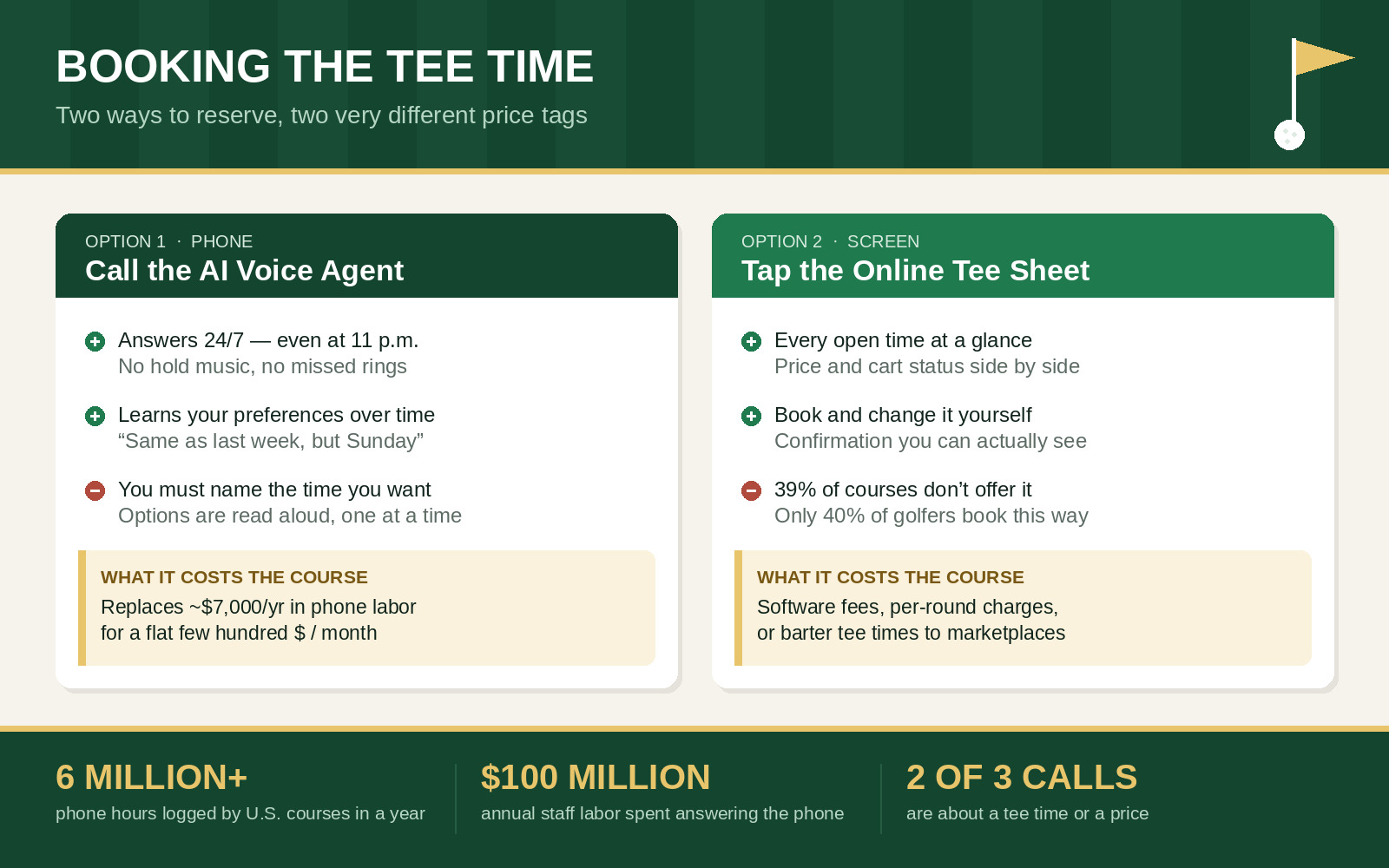
Start with an inconvenient fact: roughly 39% of golf courses still do not offer online tee time reservations at all. At those facilities the phone is not a backup option, it is the only door. And even where online booking exists, adoption lags — the National Golf Foundation reports that only about 40% of golfers book tee times mostly or exclusively online, compared with 80% to 90% for flights, hotels, and rental cars. The screen is not winning by default.
We have been here before
Golfers with some mileage on them will find the pitch familiar. In the late 1990s and early 2000s, courses and municipal systems installed automated tee time lines built on Dialogic voice boards — four analog ports to a card, dropped into a PC in the back office, playing prerecorded prompts and listening for touch tones. Need more lines? Add another card. Those systems were open 24 hours, booked rounds without a human, and required the caller to direct them: enter your member number, enter the date as four digits, press 1 for morning, press 2 to hear the next available time.
So is an AI agent genuinely different, or is it a menu tree with a nicer voice?
Is the customer service actually better?
In three respects, yes — and they are the ones that matter.
Input. Touch-tone gave you twelve keys and a script you had to learn. If your request did not map to a menu branch, there was no way to express it. An AI agent takes “anything after two on Sunday for three of us, and can we get a cart?” in one sentence instead of six keypresses and a wrong turn.
Memory. The Dialogic system was stateless. It might match a member number, but it learned nothing. An AI agent builds a preference profile: the regular foursome, the 9:10 over the 7:40, the fact that you walk. Over a season the call gets shorter rather than longer, which no IVR ever managed.
Exceptions. Touch-tone dead-ended. Ask about aeration dates, the dress code, or a rain check and you got “press 0 for an operator” — after hours, call back Monday. An AI agent answers, takes a message, or hands off.
What has not changed is the part some golfers care most about: it is still not a person. It will not squeeze a fivesome onto a full sheet as a favor, and it does not know the starter owes you one. Touch-tone taught the industry a lesson worth keeping — golfers abandoned those systems in droves, and automation that frustrates costs more in lost rounds than it saves in wages. AI clears a far higher bar than a 2002 phone tree, but it has to clear it on every call.
The labor hiding in the handset
The economics are why operators keep trying. NGF estimates U.S. courses logged more than six million phone hours in a single year, at a labor cost exceeding $100 million. The average facility fields 40 to 50 calls a day, two-thirds of them about reservations and pricing — roughly $7,000 a year per course spent on an assistant pro reading times aloud instead of selling gloves or greeting players.
An AI agent answers all 50 at once for a few hundred dollars a month — a fraction of the labor it displaces, and cheap against the rounds lost to calls that ring out at 6:40 on a Saturday.
What the golfer gives up
A voice agent still makes you do the steering. You have to know, or describe, the time you want. “Anything Saturday?” invites a list read aloud one slot at a time, and comparing five options by ear is slower and less certain than seeing them at a glance.
A booking page solves exactly that. It shows availability, price, and cart status at once, and you can scan three courses in ninety seconds. That convenience is not free either: tee sheet platforms carry subscription fees, per-round charges, or barter tee times surrendered to third-party marketplaces — precisely why so many smaller courses never adopted one.
The answer is both
Golfers who know what they want will call. Golfers shopping for the best window will open the app. Courses that offer both, sharing one preference profile between them, will win the booking and the round.