Municipal golf occupies a peculiar place in American civic life. It is, at once, one of the most genuinely democratic institutions a city owns and one of the most quietly mismanaged.
The same course that introduces a child to the game — a child who may never see the inside of a private club — can also be losing money every year, deferring the maintenance that keeps it alive, and drifting toward a day when its bills land on taxpayers who have never played a round. Both things are true, and any honest conversation about municipal golf has to hold them together.
Start with what is worth defending.
A municipal course is the front door to golf. It is where the game is affordable, unpretentious, and open to anyone who can scrape together a green fee. For a young person of modest means, it may be the only place where the game is even reachable. And golf, nearly alone among sports, teaches by requiring. It asks a player to call penalties on himself when no one is watching, to keep his composure over four unhurried hours, to show courtesy to strangers, to repair the ground he has damaged, and to accept that the same swing can reward and betray him on consecutive holes.
These are life lessons that have great value: honesty, patience, etiquette, perseverance, humility — these are not slogans on a range banner; they are the actual benefits that the game of golf provides.
For decades, the municipal course has been the game’s great equalizer — the place where a groundskeeper’s child and a banker’s child play the same holes under the same rules. That equalizing function is not incidental to public golf; it is much of the reason it deserves public support in the first place. A city that opens that door for its young and the community is doing something genuinely valuable.
None of that, however, justifies what many municipal courses actually do: sell the game below cost to everyone — including the affluent adult regulars who need no help at all.
There is a difference between a mission and a giveaway. Subsidizing a junior clinic, a learn-to-play program, or a First Tee chapter is an investment in the public purpose that makes municipal golf worth owning. A discounted prime‑time Saturday tee time offered to a well‑established businessperson or a financially comfortable retiree—individuals who would readily pay full rate—does not serve the course’s best interests. It is worth underscoring that the median household income of an American golfer is $109,638, according to the National Golf Foundation, compared with $81,624 for the general population.
When a course prices every round below its true cost, it does not widen the door; it simply transfers money from the general public to whoever happens to play most often — a group that, by every available measure, skews wealthier than the median resident.
While many municipalities structure their golf courses within an Enterprise Fund—designed to operate as a self‑sustaining business supported by user fees—the financial realities still arrive with a rhythm as familiar and predictable as the changing seasons. Greens, irrigation systems, cart paths, and clubhouses wear out. A responsibly run enterprise prices its product to cover not only daily operations but also the slow depreciation of these assets, setting aside reserves for their eventual replacement.
Many municipalities price to please the loudest regulars, post operating losses year after year, and save nothing. When the irrigation finally fails, the city has no reserve to draw on. It turns to general-obligation bonds — debt secured by every property owner’s taxes and repaid by the whole community.
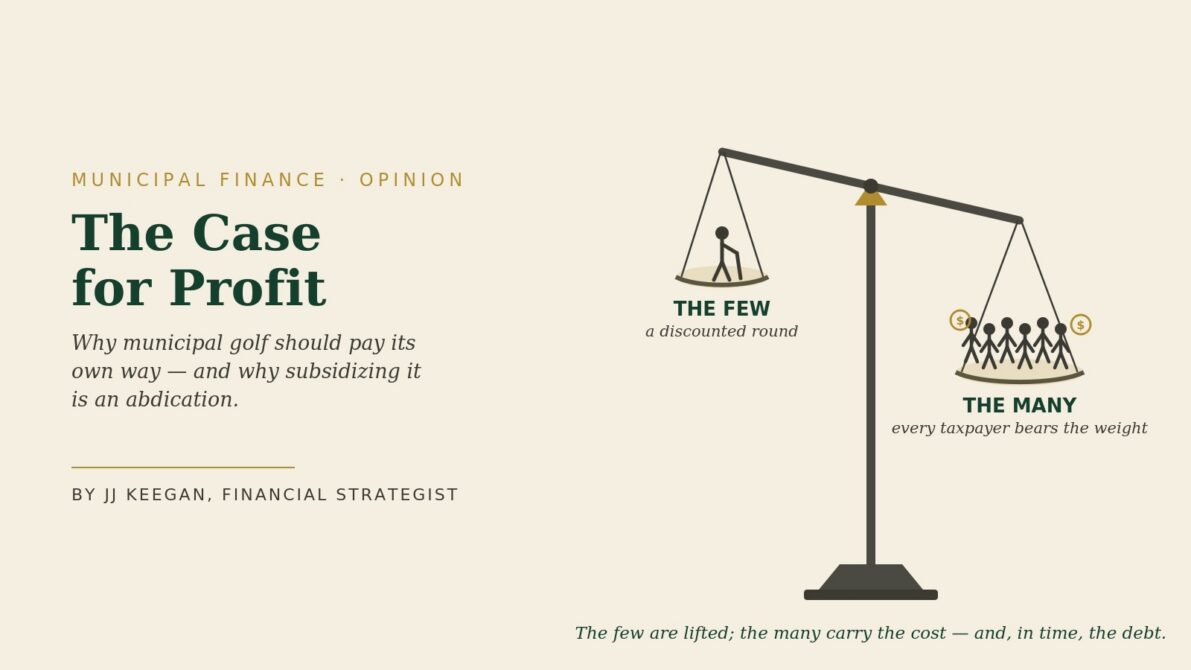
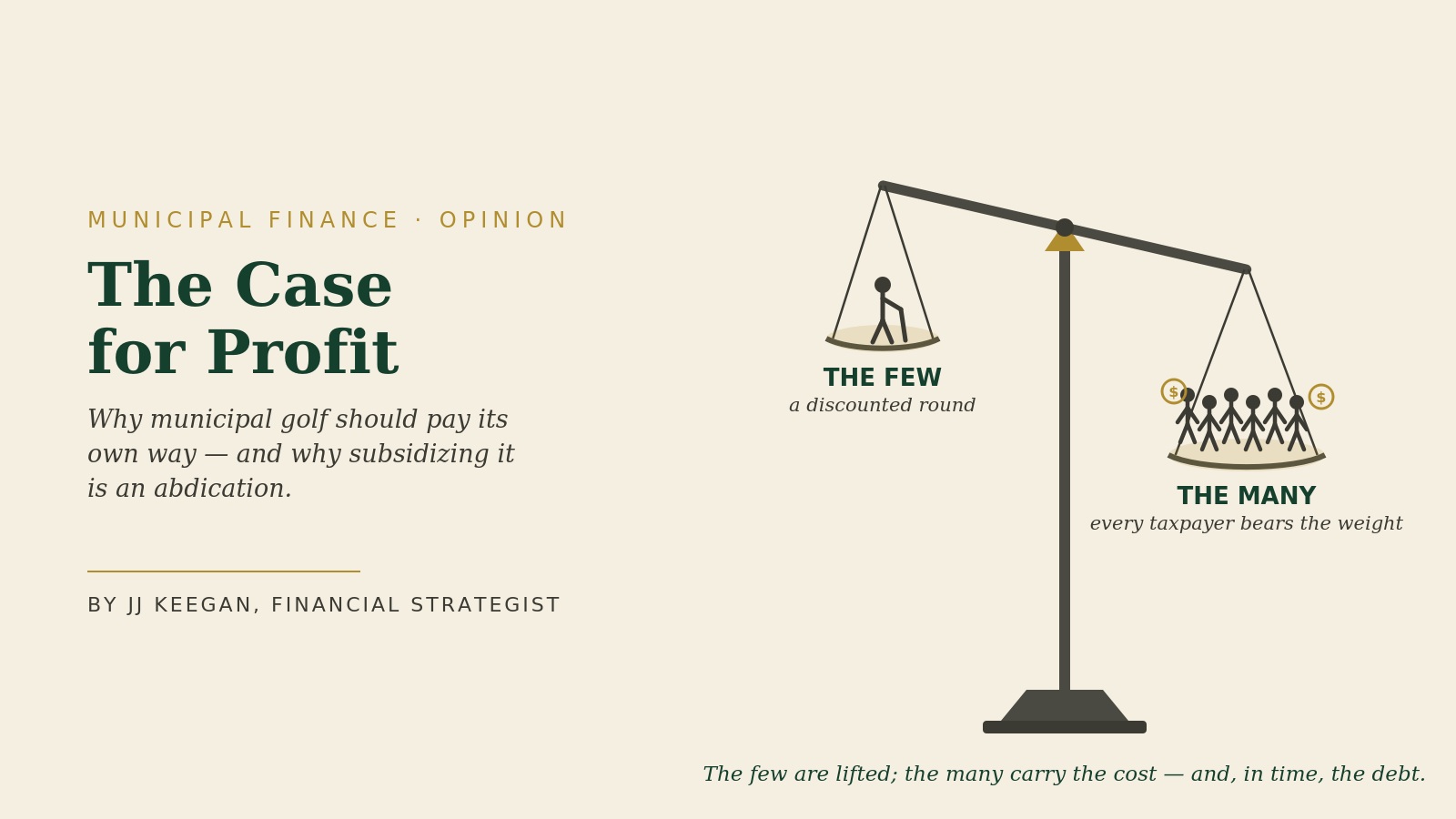
A capital failure caused by years of underpricing is thus socialized across the entire population, including the very families the course’s mission was meant to serve. The few enjoyed the discount; the many inherit the debt. This is the real abdication.
It is the failure to price the game so that it can fund both its future and its purpose. Elected officials owe a fiduciary duty to the whole community, not to the constituency that lobbies hardest at budget time. Blanket below-cost pricing does not protect access; it quietly endangers it, because the first thing a cash-starved course cuts is the junior program, the beginner rate, the outreach — the mission itself — in a scramble to keep the lights on for the regulars. The giveaway devours the very thing that justified it.
The alternative is neither radical nor stingy.
Demand for golf is strong and, in many markets, historically high; players have shown they will pay for a quality experience. Price adult and prime-time play to full cost recovery — operations, a funded capital reserve, and a modest surplus — and the enterprise becomes the engine of its own mission. That surplus can underwrite genuinely subsidized junior rates, need-based access, veterans’ programs, and the First Tee, while the reserve renews the course without borrowing against the public.
Profit, in this light, is not the enemy of access; it is what keeps the door open. The mission is not charity bolted onto a business — it is the dividend the public earns on a business run well. A solvent course can afford to be generous; an insolvent one cannot afford anything at all.
So the two truths reconcile more easily than they first appear.
Municipal golf earns its place in a city’s portfolio because it is the game’s front door and one of the few schools of character still open to any child willing to walk in. Precisely because that mission matters, the enterprise must be run with discipline: charge those who can pay the full freight, invest the proceeds in the young and the newcomer, and never send the invoice for a wealthy foursome’s discount to a household that has never held a club. That is not a betrayal of public golf. It is the only way to keep it public.
Failure to do so is a true abdication by City Council: charging too little — and sending the invoice to everyone else.



Douglas Lyle
Thoughts for your follow up article.
Purpose of forming a city
Fire, police, courts, water, streets, governance?
Recreation? Open spaces? Swimming facilities? Ball fields and courts? Exercise facilities?
Funding? General progressive taxes and individual participation fees? What is the blend for each type of recreation?
Is means testing more doable now than previously? Is age a fair discriminator? Is competition between private facility providers and tax funded municipalities a concern?
I look forward to your next article.
Whitey O'Malley
Great article JJ….I have been wondering how to articulate this exact sentiment, you nailed it.
Joe Carabello
Nice work cutting to the chase, JJ! This was a deep dive into a reality that few – if any of us – have considered.
Kudos!
Leo McMahon
Great article