
 For more than two decades, online tee-time platforms have reshaped how golfers discover and book their rounds. Among the most prominent is GolfNow, whose barter-based model has become a fixture of the industry. Under that arrangement, a golf course typically provides the platform a set number of tee times each day—often up to three—for the platform to sell, in exchange for access to its booking and marketing software. For many operators, it is a pragmatic trade: technology and reach in return for inventory.
The model has never been free of criticism. Both the National Golf Course Owners Association (NGCOA) and voices within the PGA have questioned barter arrangements for years, citing concerns about pricing control, brand dilution, and the long-term economics for course owners. And yet the model has proven remarkably durable. Many operators—including several of the largest management companies—continue to license the software, a testament either to its genuine value, its convenience, or the simple difficulty of walking away from an established distribution channel.
It is against that backdrop that a single, ordinary reservation highlighted below deserves a closer and entirely respectful look, but as an honest question about transparency.

GolfNow reservation confirmation, Meadow Hills Golf Course, August 1, 2026.
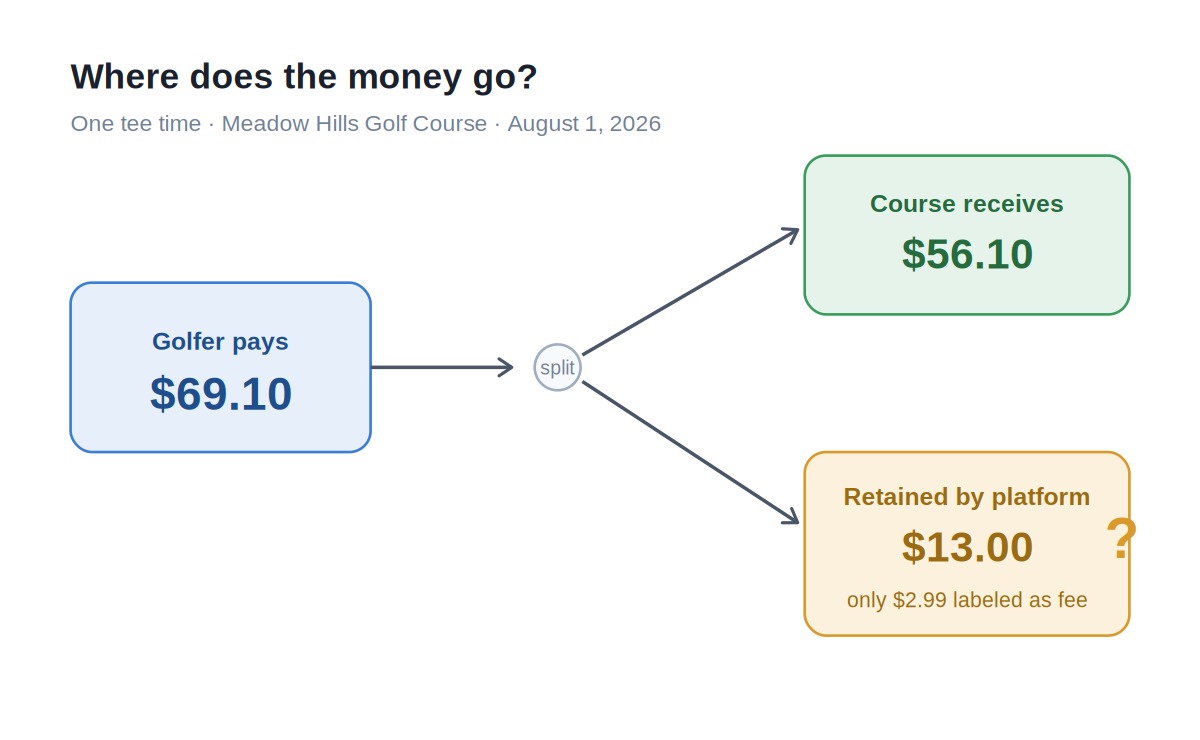
The confirmation reproduced here lays out the numbers plainly. On August 1, 2026, a single-player, 18-hole tee time was booked at Meadow Hills Golf Course in Aurora, Colorado, through GolfNow. The green fee is listed at $66.00. A convenience fee of $2.99 and estimated taxes of $0.11 bring the total to $69.10. Of that sum, $13.00 was paid online at the moment of booking, leaving $56.10 due at the course.
Where the Arithmetic Invites a Question
According to the on‑site golf professional we spoke with at check‑in, the course receives only the $56.10 portion of the transaction. If that account is correct, then roughly $13.00 of the golfer’s total payment—the amount collected online—never reaches the course.
The stated $2.99 convenience fee retained by GolfNow explains only a small part of that difference. A reasonable customer might wonder where the remaining amount goes, and whether it represents an additional fee retained by GolfNow beyond the value of the up to three bartered tee times provided each day.
It is worth saying clearly that none of this is necessarily improper. Platforms deliver real services—software, payment processing, marketing, and demand generation—and they are entitled to be compensated for them. A barter model, by definition, means the platform earns partly through the tee times it is given to sell and partly through fees. But the specific structure of this receipt raises a fair transparency question: can the customer clearly see how much of what they pay actually reaches the course, and how much is retained by the platform?
Why the Question Matters
That question matters for two audiences. For golfers, clarity builds trust. A customer who assumes the full green fee supports the course they are playing may feel differently on learning that a share is retained elsewhere. For course operators, the concern is sharper still. If a growing portion of each transaction is captured before funds reach the pro shop, the economics of a model already debated for twenty years deserve a fresh and honest examination.
There is also the matter of rebates, which have long been the subject of industry conversation. It has been suggested—though, to be fair, not publicly established—that some management companies favor particular booking platforms in part because they receive rebates on fees booked at the courses they manage. If such arrangements exist, they raise a legitimate governance question: are software decisions being made in the best interest of the individual course and its owners, or in the interest of the management entity? This is not an allegation against any specific company. It is precisely the sort of question that transparency would readily put to rest.
A Question Asked in Good Faith
The intention here is simply to offer perspective—not to fault GolfNow, which operates openly in a competitive market, nor to overlook the meaningful support its technology provides to thousands of courses. It is, rather, to ask whether the presentation of a modern tee-time transaction has kept pace with the principles of clear disclosure that customers and operators reasonably expect. When a golfer pays $69.10, and the course receives $56.10, the difference is not scandalous on its face—but it is worth explaining.
Perhaps the model has simply evolved, and the split between online and in-person payment reflects nothing more than ordinary cost recovery for services rendered. Perhaps a fuller accounting would lay every concern to rest. That is exactly why the question is worth asking, plainly and without rancor: in an industry built on trust and tradition, shouldn’t every party—golfer, operator, and platform alike—be able to see exactly where the money goes?


Mike Loustalot
Maybe this course is paying a commission instead of trade?
JJ Keegan
They are paying an additional 3 times per day, according to the Meadow Hills Staff.
Whitey O'Malley
Another great article…I would agree that these 3rd party interlopers brought a bit of value when they were able to search for times in a general market area. Now with the advent of default AI searches, these consolidators are being end runned and the value of having consolidated tee times is drastically reduced.