If you own or manage a golf course, you have probably wondered whether your rates have climbed about as high as they can go. Over the past five years, many owners have raised prices, and some now worry they are nearing a ceiling — a point where higher rates finally start to push players away. It is a fair concern, and it is worth thinking through carefully.
Here is the encouraging news: the numbers suggest there is still room to grow. Rounds played are up 4.2% through June 30, 2026, and the year is on pace to set a new record. That tells us demand remains strong and continues to outpace supply.
Consider a real example. In the Denver metro area on Saturday, August 2, there was only one tee time open for a twosome before 3 p.m. — and that was across 30 regulation-length courses along the Front Range. When tee times are that hard to find, demand is clearly very high.
So the real question is not simply, “Can we raise prices?” It is, “How do we price each tee time in a smart way?” And the answer is more interesting than a single number.
It Is About More Than Price
Raising the rate is only one lever. A smarter approach also considers who your golfers are and what they want from their round. The way a golfer feels about the experience matters just as much as the price they pay. Most courses do not fully account for this — and that is exactly where the opportunity lies.
Know Your Four Types of Golfers
Public golfers tend to fall into four groups, and each one values a tee time in its own way:
- Prestige seekers (about 20% of demand) are higher-income golfers who care about playing the “right” tee time.
- Social players (about 35% of demand) are middle-income golfers who play with friends and pay attention to what others are doing.
- Recreational and casual golfers (about 30% of demand) play for fun and are looking for a good deal.
- Competitive and league players (about 15% of demand) play in tournaments and leagues. Their tee times are set by a schedule, so they show up no matter what.
When you understand these groups, you can see why the same price change can affect each of them very differently.
Six Factors That Shape the Value of a Tee Time
Several details influence how much each group is willing to pay for a tee time. Here are six of the most important:
| Factor | What It Means |
| Time-of-Day Prestige | A holiday morning versus a mid-day tee time during the week. |
| Course Condition | Fast greens (stimping over 11), crosscut striping in the fairways, several cuts of rough, and hand-raked bunkers — versus a basic, fair layout. |
| Social Visibility | A national or regional ranking that marks the course as a premium experience. |
| Scarcity / Exclusivity | How far ahead you must book. For example, Bandon Dunes and Rodeo Dunes are already sold out for 2027 and are taking booking requests for 2028. |
| Weather Amenity | Comfortable temperatures between 65 and 75 degrees during the four-hour round. |
| Seasonal Prestige | Playing in Arizona, Florida, or Hawaii during the winter. |
The Tee-Time Status Index (TSI)
When you combine a golfer’s group with the experience you offer, you get what we call the Tee-Time Status Index, or TSI. It is a score from 0 to 100 that measures how desirable a specific tee time feels — separate from what it costs. The TSI pulls together the six factors above and helps you set the right price. Here are a few examples:
| Tee Time | TSI | Tier | What Drives the Score |
| Holiday Morning | 83.6 | Premium | Scarcity (90) and time-of-day (95) — everything peaks at once. |
| Early Weekend Morning | 78.0 | High | Prime time (90), with nearby slots filling up (scarcity 80). |
| Prime Weekend Afternoon | 71.0 | High | Good visibility (78), but weaker scarcity (65). |
| Midweek Midday | 51.0 | Moderate | Nothing scarce, no audience, and a so-so time (45). |
| Twilight Weekday | 39.0 | Low | Low on time (25), scarcity (20), and visibility (35). |
A Simple Model You Can Use
To make this practical, we created a free spreadsheet. Merely email at jjkeegan@jjkeegan.com for a copy. The model predicts two things: how many rounds people will book, and how much money your course will make. It works by answering one key question: if you change the price of a tee time, or make it feel more special, how many golfers will book it?
At its heart, the model uses a simple formula:
Rounds = Base Rounds × Segment Share × Price Effect × Status Effect
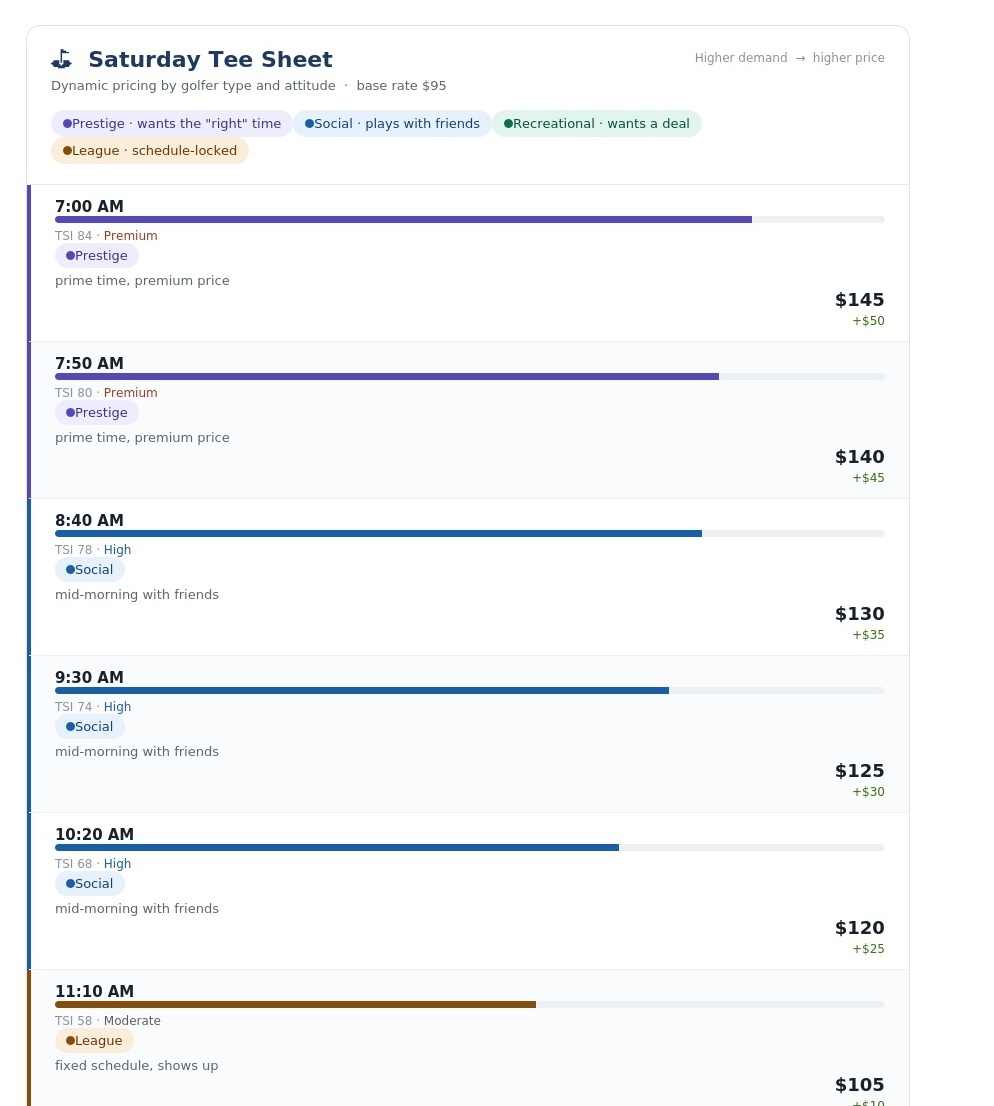
The model runs this formula four separate times — once for each type of golfer — and then adds the results together. This step matters, because different golfers react in very different ways to the same price change. The tee sheet might look like this:
 The Hope
Our hope is that this gives you a clearer, more confident way to price your tee times. You do not have to guess, and you do not have to lean on price alone. By understanding your golfers and the experience you offer, you can set prices that feel fair to players and still grow your revenue.
You have built something people clearly want to be part of. With the right model in hand, you can make the most of that demand — thoughtfully, and with confidence.