Where Golf Revenue Leaks Even With Demand Pricing
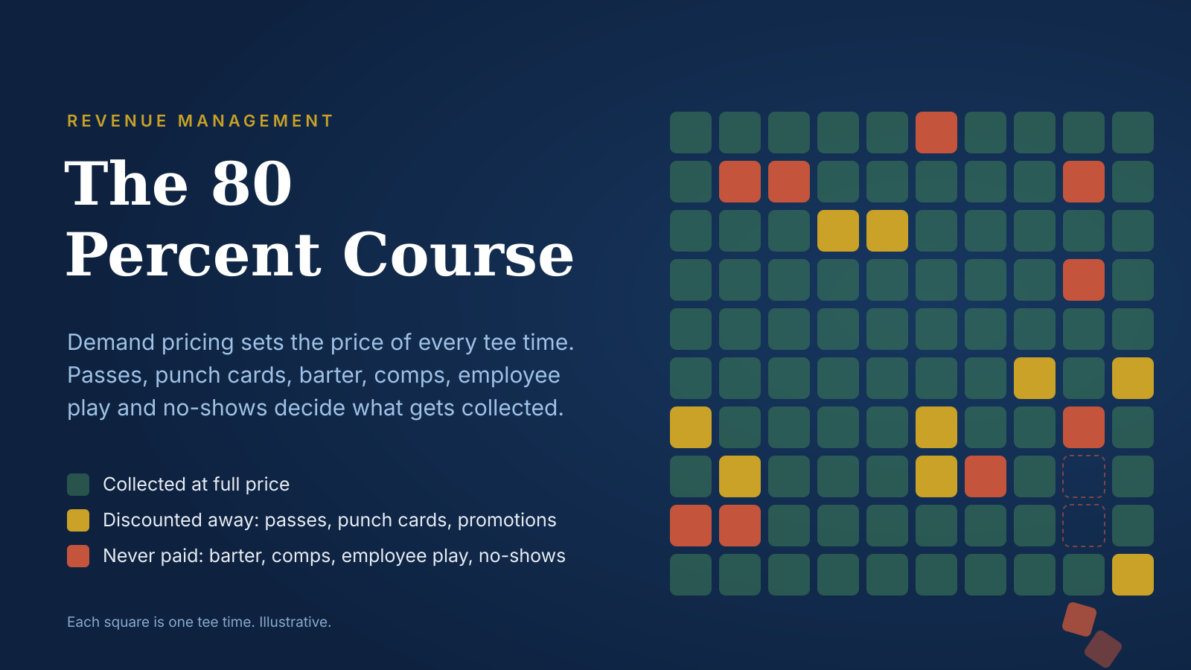
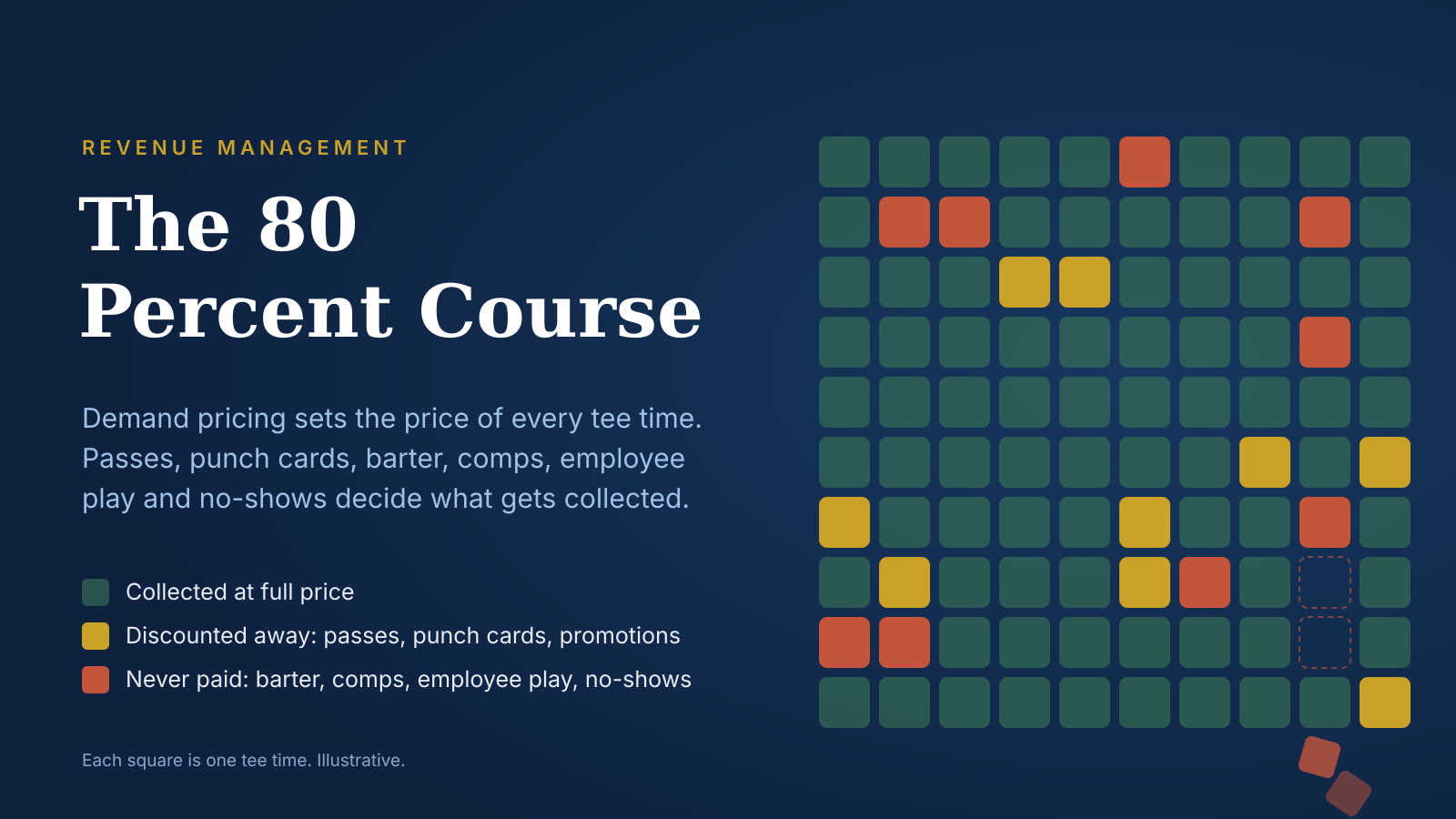
Demand pricing is only as effective as the management discipline behind it. A golf course can establish the optimal price for every tee time, but that pricing strategy has limited value when owners and operators fail to manage their inventory efficiently. In the courses we review, operators may realize only about 80 cents of every dollar their tee-time inventory has the capacity to produce. The remaining 20 cents can represent a significant revenue gap created not by insufficient demand, but by management practices that allow valuable inventory to be sold below its potential value, given away, or left unused.
The revenue erosion often develops quietly. Annual passes may be priced without adequately considering actual utilization. Punch cards may provide discounts greater than their economic value warrants. Barter arrangements and complimentary rounds may consume otherwise sellable inventory. No-show policies may fail to protect revenue, while employee or other non-revenue play may occupy prime tee times that could have been sold at market rates.
The greater concern is that these are largely controllable management issues. When owners and operators do not rigorously measure, price, protect, and account for their tee-time inventory, relatively small inefficiencies can compound into a substantial structural revenue problem. The result is not simply a few discounted or unused rounds. It is the systematic erosion of the golf course’s revenue potential and, ultimately, its financial performance. Once a tee time passes underpriced or unused, that revenue opportunity is permanently lost.
Two recent engagements demonstrate just how significant the financial consequences of inefficient tee-time management can become.
Example 1: A premium daily-fee course collects 57 cents on the dollar
A professionally managed daily-fee course generates more than $5 million in annual revenue, supported by a blended public rate of approximately $186.50 per round. At the same time, its discount and annual-pass programs reduce potential revenue by more than $910,000 annually.
The principal discount program charges an annual fee of $1,250 and provides participants with a 50% discount from the posted rate before 3:00 p.m. and 60% thereafter. Approximately 250 passes are sold. The course also offers an unlimited annual pass for $5,050, with approximately 40 passes sold. For a golfer playing 75 rounds, the unlimited pass reduces the effective cost to about $67 per round, approximately 64% below the blended public rate.
Additional promotions further reduce the effective yield, including 10-round member packs at $65 per round, a November “Cyber” sale offering five-round packs at $95 per round, and two complimentary rounds provided with qualifying merchandise purchases.
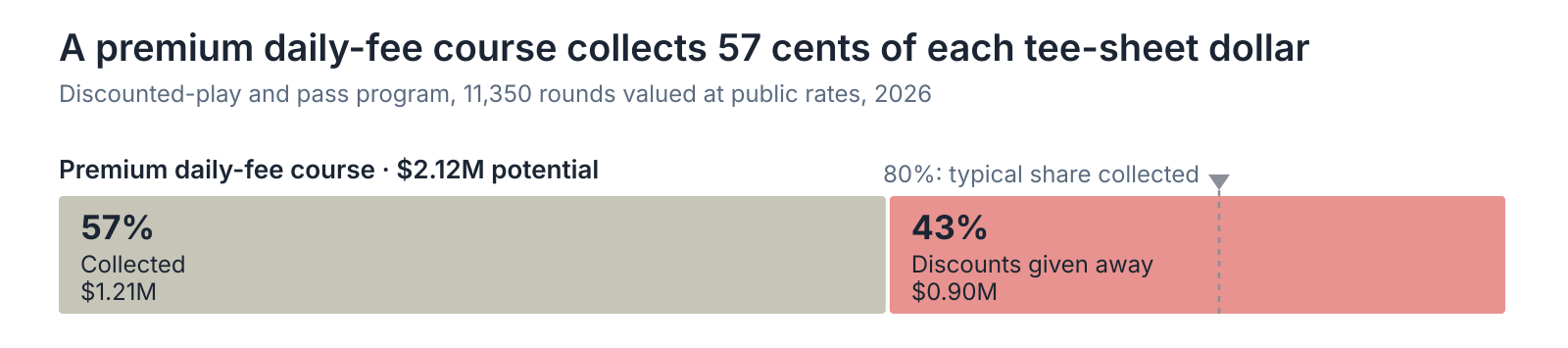
Collectively, these programs accounted for approximately 11,350 rounds, valued at $2.12 million at posted public rates, while generating approximately $1.21 million in revenue. This represents a yield of only 57% of the corresponding public-rate value and an annual revenue differential of approximately $910,000.
Example 2: A municipal system loses it in the reservation book
A two-course municipal system in the Mountain West collected about $5.46 million in 2026 tee-sheet revenue and already uses demand-pricing software. Still, about one booking in seven at its busier course and one in six at the other is a no-show. Further, their nine-hole times are priced at 50% of the 18-hole rate, compared with the industry average of 66% – the U.S. median is 66% (GreenFeeTracker, 1,491 courses, Nov. 2026). Management puts about $990,000 a year at risk.
Also, employees played 2,671 rounds, worth $174,000 with carts at posted rates. They booked up to seven days ahead through the public system, with no monthly limit and no rate code to track them. Counting those three leaks alone, the system collects about 82% of its potential. 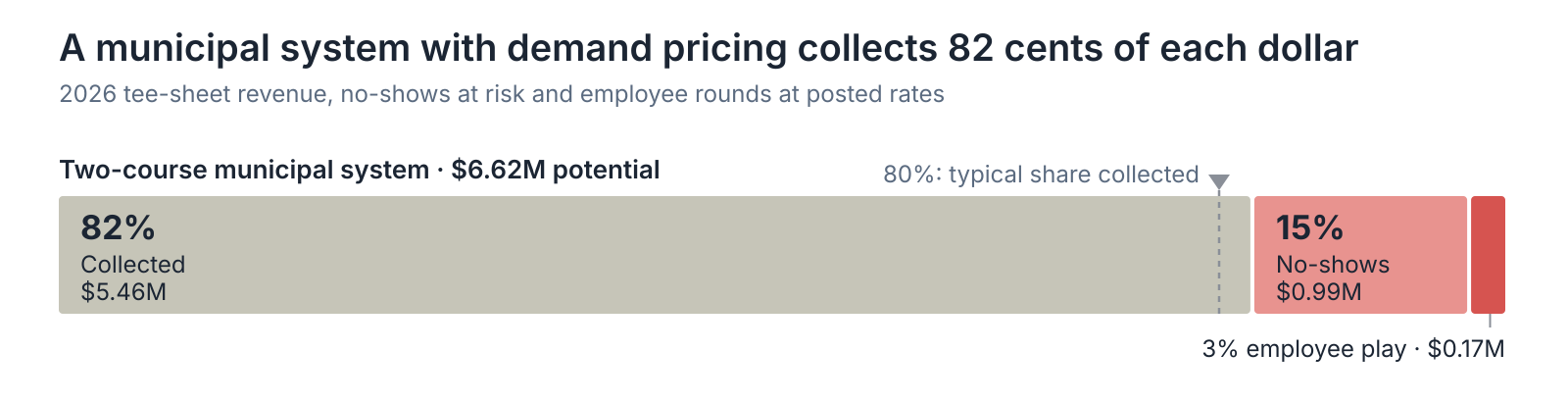
The tax exposure owners overlook
Free employee golf is tax-free only when it costs the course nothing. Internal Revenue Code §132 excludes a “no-additional-cost service” from an employee’s income. But the Treasury regulation counts revenue forgone when a service goes to an employee rather than a customer as a cost. An employee who books a Saturday morning time days ahead takes a paying golfer’s round. That round may then be taxable pay the course should report. That is what airline employees fly “stand-by” – to avoid the consequences of taxable compensation requiring withholding by the employer.
Rounds given to a concessionaire’s staff need a written reciprocal agreement to qualify. Barter carries its own rule: the IRS treats the fair market value of services received in trade as income to both parties. Tee times traded for radio ads are revenue, not a marketing footnote. Owners should review each practice with their tax counsel.
Measure the leak before you set the price
Most operators cannot name their realization rate because no report shows it. The companion Revenue Realization Audit workbook does. Enter each channel’s rounds, the cash it collected, and the share of its rounds that displaced a paying golfer. The workbook values every round at posted rates, ranks the leaks, and flags practices that carry tax risk.
The fixes are policy, not software:
- Price passes to break even at the rounds holders actually play.
- Cap punch-card and package discounts.
- Hold every tee time with a credit card.
- Limit employee play to unsold times booked within 24 hours, under its own rate code.
- Record every barter at fair market value.
Demand pricing sets the price. Policy decides whether you collect it.